Cohere Labs Tiny Aya
Captured source
source ↗North Mini Code. Cohere's first model for developers.
Feb 17, 2026
7 minutes read
Cohere Labs Launches Tiny Aya, Making Multilingual AI Accessible
_Open-weight AI designed for real-world languages that is powerful, adaptable, and efficient enough to run locally, even on a phone._
Today, Cohere Labs, Cohere’s research arm, is introducing Tiny Aya, the most capable multilingual open-weight model at its scale. Tiny Aya delivers state-of-the-art translation quality, strong multilingual understanding, top-quality target language responses, and broad language coverage in a model small enough to run locally, even on consumer hardware and mobile phones. No barriers to experimentation, just a powerful family of models that can run anywhere.
Multilingual AI has made rapid progress, but performance and usability still concentrate around a small set of dominant languages and large-scale infrastructure. Tiny Aya takes a different approach: combining efficient design with deep multilingual research to support balanced performance across languages while remaining practical to deploy and adapt. Instead of shallow coverage across hundreds of languages, Tiny Aya emphasizes meaningful multilingual depth enabling researchers, developers, and communities to build AI that reflects their own linguistic and cultural contexts.
What We're Releasing
TinyAya-Base, a pretrained 3.35B-parameter model: TinyAya-Base covers 70+ languages\*, including many lower-resourced languages from around the globe.
TinyAya-Global, a powerful instruction-tuned multilingual model: Built on top of TinyAya-Base, TinyAya-Global delivers strong, balanced performance across 67 supported languages. It serves as the default truly multilingual system, ideal for applications that require consistent quality across diverse linguistic settings in a single deployment.
A family of specialized instruction-tuned models: Alongside TinyAya-Global, we’re introducing specialized variants that deepen performance within specific linguistic regions while maintaining strong multilingual capability more broadly. This structure combines shared cross-lingual learning with targeted regional depth giving researchers and builders flexibility in how they deploy multilingual AI (details of the model variants and regional specializations are described below).
A new massively multilingual fine-tuning dataset and benchmarks: Covering multiple domains, languages, and tasks, these resources provide a foundation for systematic multilingual experimentation, enabling reproducible evaluation and continued exploration of data-centric training strategies.
**A detailed technical report** : Sharing the research, training strategy, and evaluation insights behind Tiny Aya.
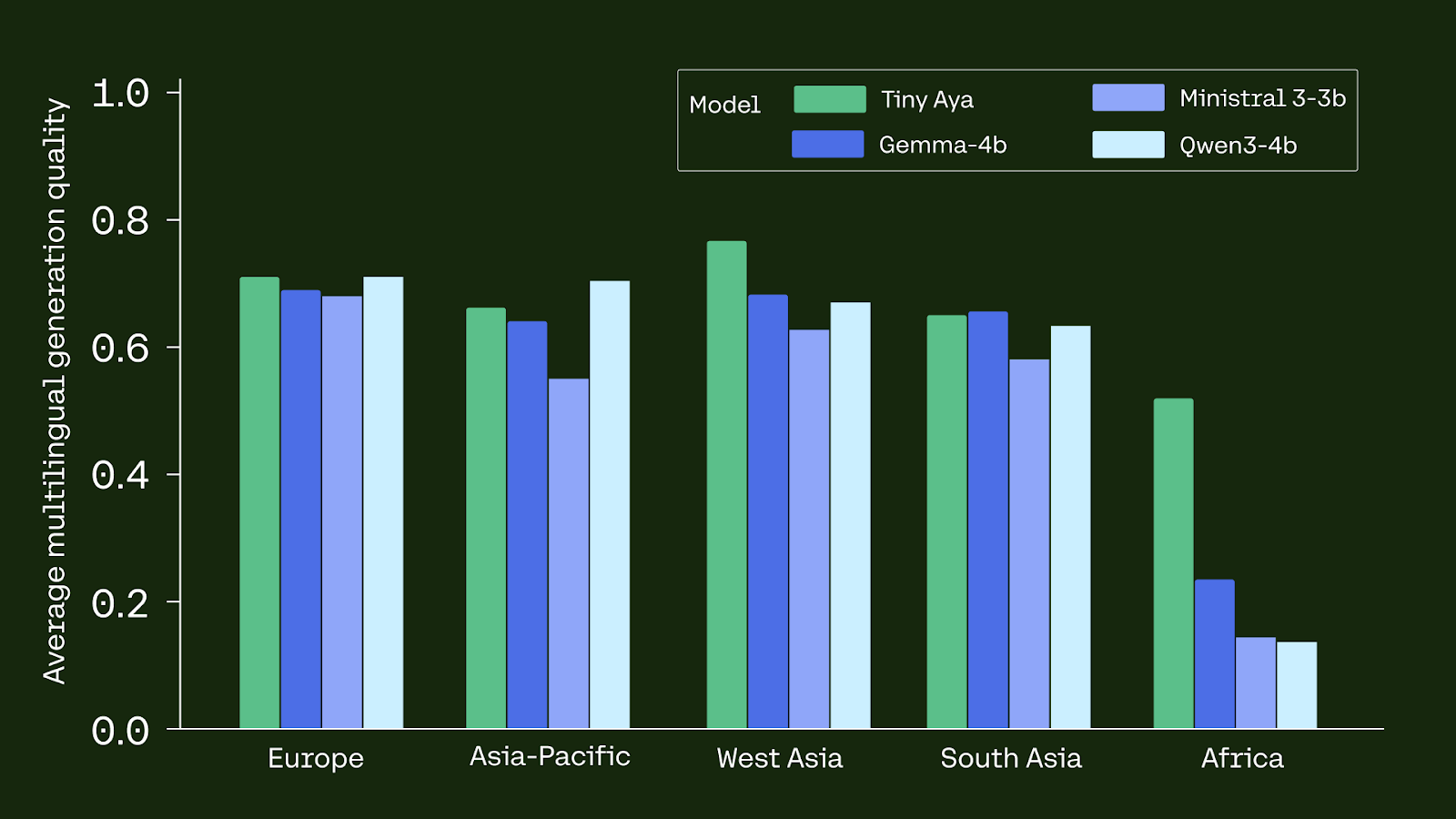_The instruction-tuned models from the Tiny Aya family perform competitively with existing massively multilingual models at this scale. Aggregating benchmark performance on our focus languages across multiple tasks (translation, language understanding, mathematical reasoning, and open-ended generations on both technical and non-technical domains), we find that Tiny Aya is advancing the state-of-the-art in generative multilingual AI at this scale across all languages from West Asia and Africa._
Tiny Aya represents a shift in how we think about how multilingual systems are built and shared. With efficient design, deep research into multilingual pretraining and post-training, and a focus on linguistic diversity from the ground up, Tiny Aya brings high-quality AI closer to the people who need it most: researchers working on underrepresented languages, developers building locally, and communities shaping technology on their own terms. For example, a university lab in India could deploy Tiny Aya as an offline translation or AI education tool in classrooms and community settings without relying on cloud APIs.
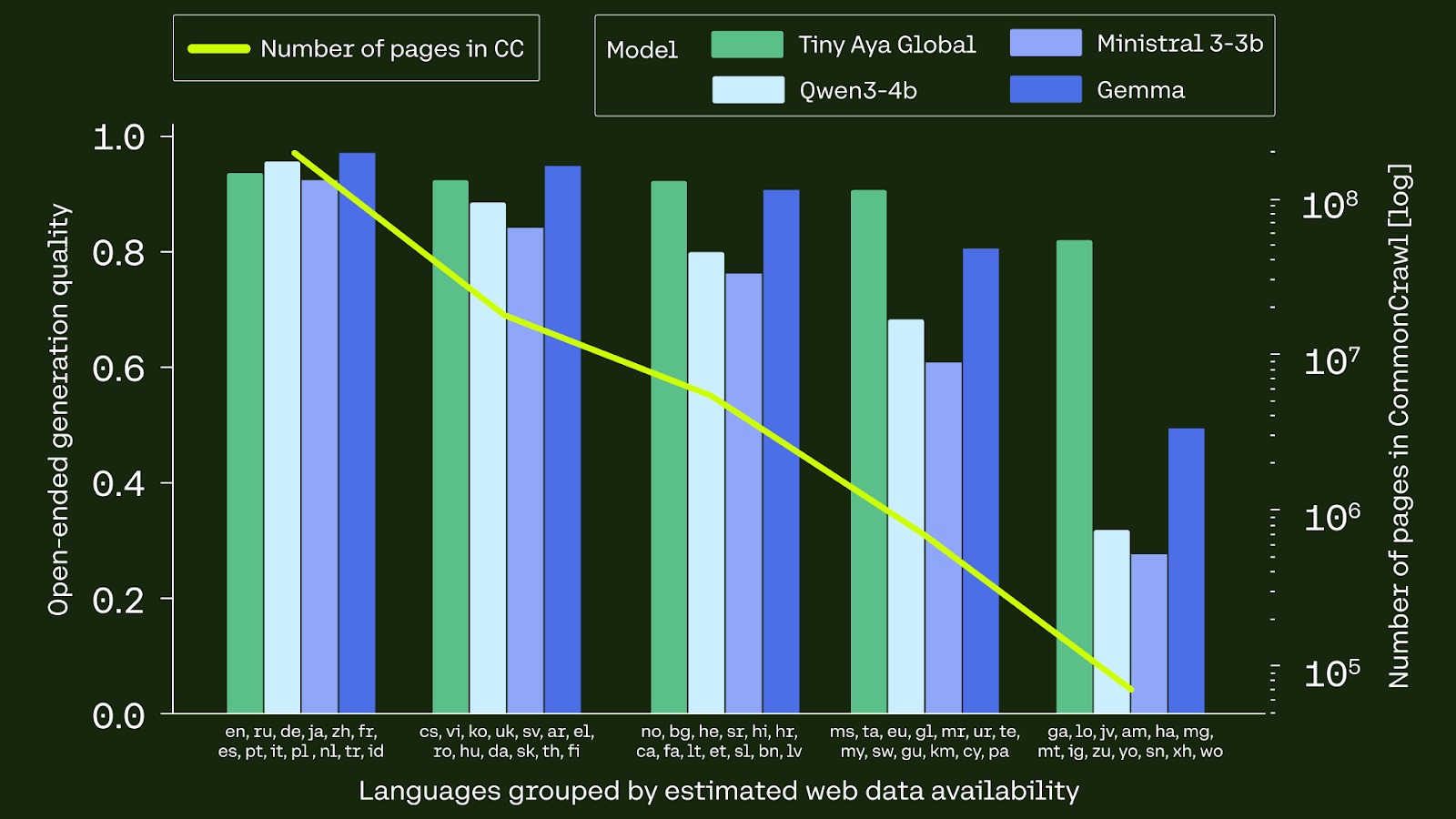_The dominance of languages on the web, here measured by page counts in CommonCrawl, typically steers the performance across languages in multilingual LLMs. Tiny Aya maintains stable performance even for languages that are under-represented on the web (the right end of this graph), and advances their inclusion in multilingual AI._
Technical Innovation
Tiny Aya is grounded in several years of research from the Aya initiative on how multilingual models can scale responsibly. In particular, the training approach builds on our recent research around increasing language plasticity through tokenization, increasing naturalization of synthetic data, smart fusion of diverse generations and targeted selection of merging methods. Together, these methods allow multilingual signals to be combined while preserving linguistic nuance and strengthening language-specific structure.
Another core design principle behind Tiny Aya was efficiency under realistic compute budgets. By completing post-training on a single 64 NVIDIA H100 GPU cluster, we demonstrate that careful multilingual data design and training strategy can substitute for brute-force scaling. These ideas shaped Tiny Aya from the ground up, guiding the tokenizer design, the data mixture, and the way we approached specialization across language clusters.
Tiny Aya moves beyond multilinguality as a uniform objective and incorporates strategies that preserve diversity during training while enabling efficient downstream adaptation. This design allows researchers to reshape the model without fighting against rigid alignment or over-specialized post-training, making it easier to fine-tune for new domains, emerging languages, or community-driven evaluation frameworks....
Excerpt shown — open the source for the full document.
Notability
notability 7.0/10New multilingual small model release from Cohere.